What Brand of Vacuum Lasts the Longest? (Durability Guide)
Which vacuum brand lasts 15 to 20 years? Miele and SEBO compared with Dyson, Shark and robot vacuums on repairability, parts and motor life.
Top Picks at a Glance
- Top Longevity Brand Pick #1 Top Pick
 Miele
MieleMiele Triflex HX2 Pro
Best for: German Vortex motor engineering with dual swappable battery packs that prevent obsolescence
Suction Manual - Best Modular Cordless Stick
 Dyson
DysonDyson V15 Detect
Best for: Click-in replaceable battery system and widely available official replacement parts
240 AW Dust sensor - Best Value Workhorse
 Shark
SharkShark Stratos
Best for: Solid 5 to 7 year consumer lifespan with anti-hair wrap dual roller technology
Suction Dust sensor
Prices and specs last synced September 12, 2026.
Jump to Section (6)
Quick Answer (AI Overview): Miele and SEBO are universally recognized by repair technicians and independent durability testing as the longest-lasting vacuum cleaner brands in the world.
- #1 Longest Lasting: Miele and SEBO (German-engineered bagged canisters and uprights with an expected lifespan of 15 to 20+ years).
- #2 Commercial Workhorses: Numatic (Henry) and Sanitaire (10 to 15 years with indestructible Lexan fans and cheap 5-minute field repairs).
- #3 Premium Cordless Sticks: Dyson (4 to 6 years, extended to 7–8 years if you replace the click-in lithium battery pack at year 3).
- #4 Mass-Market Bagless: Shark, Hoover, Bissell (5 to 7 years, frequently limited by unrepairable plastic clip joints and lack of official internal spare parts).
In an era of planned obsolescence where disposable appliances end up in landfills after 24 months, finding a vacuum cleaner that you buy once and rely on for decades feels like an anomaly.
Yet across the vacuum repair industry and communities like Reddit’s r/BuyItForLife, two German manufacturers—Miele and SEBO—routinely service vacuum cleaners that have been running continuously since the 1990s.
Below, we break down why certain vacuum brands last 20 years while others burn out in three, the engineering differences between bagged and bagless motor longevity, and the exact brands to invest in if durability is your #1 priority.
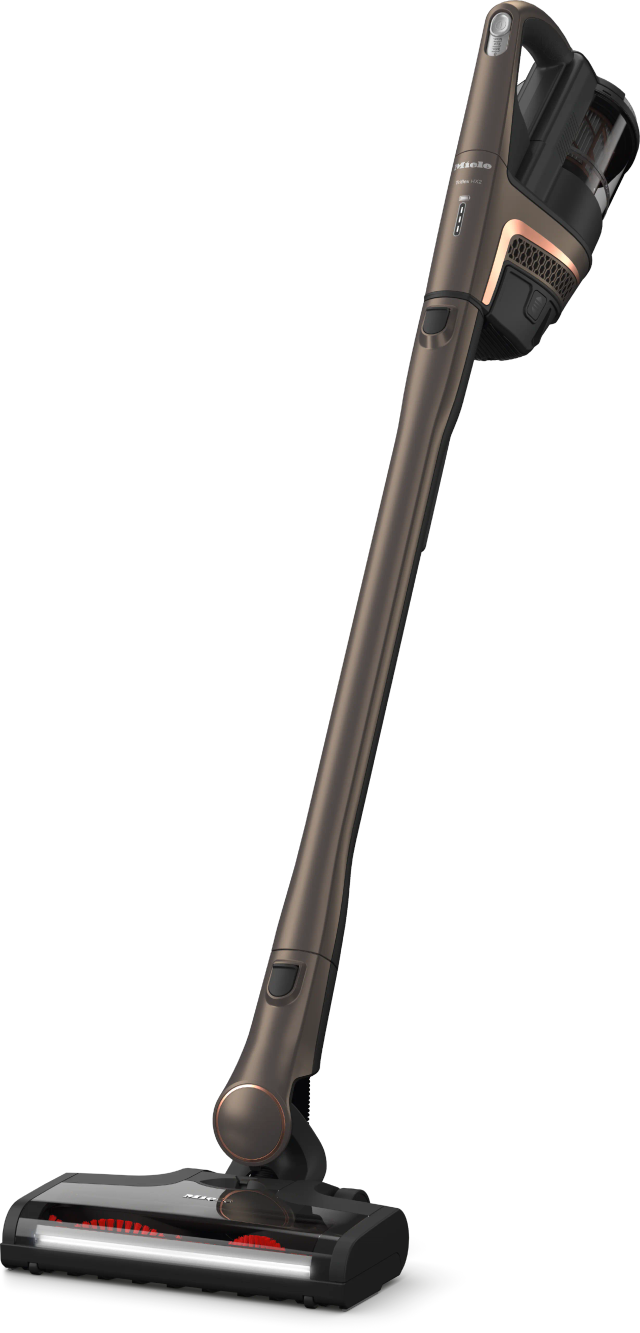
Miele Triflex HX2 Pro
Best for: German Vortex motor engineering with dual swappable battery packs that prevent obsolescence
Three-in-one configuration, two swappable batteries and a lifetime HEPA filter for allergy homes.
- Rated suction
- Not published
- Runtime
- 120 min
- Noise
- 76 dB
- Weight
- 3.7 kg
Best for
- Two batteries = 120 minutes total
- Power unit moves to the floor for upright-style comfort
- Sealed HEPA system, premium build materials
Not ideal if
- No dust sensing or auto mode
- Expensive for the feature set
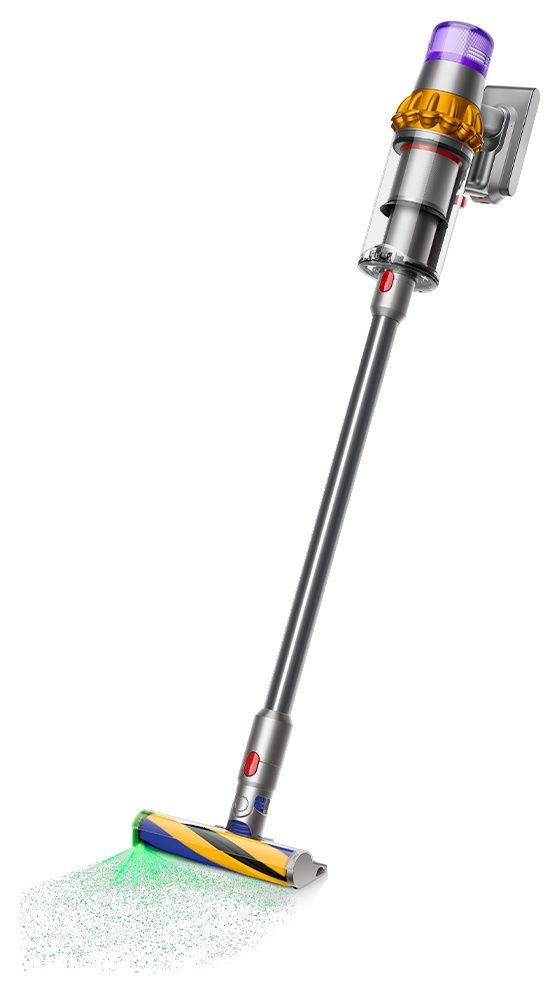
Dyson V15 Detect
Best for: Click-in replaceable battery system and widely available official replacement parts
240 AW, a laser that reveals dust and a piezo sensor that counts it — still the benchmark cordless.
- Rated suction
- 240 AW
- Runtime
- 60 min
- Noise
- 78 dB
- Weight
- 3.1 kg
Best for
- Green laser makes invisible dust obvious on hard floors
- Auto-adjusts power based on particle count
- Anti-tangle hair screw tool for pet hair
Not ideal if
- Heavy at the wrist for stair work
- Runtime drops to ~8 min in Boost mode, per Consumer Reports measurement
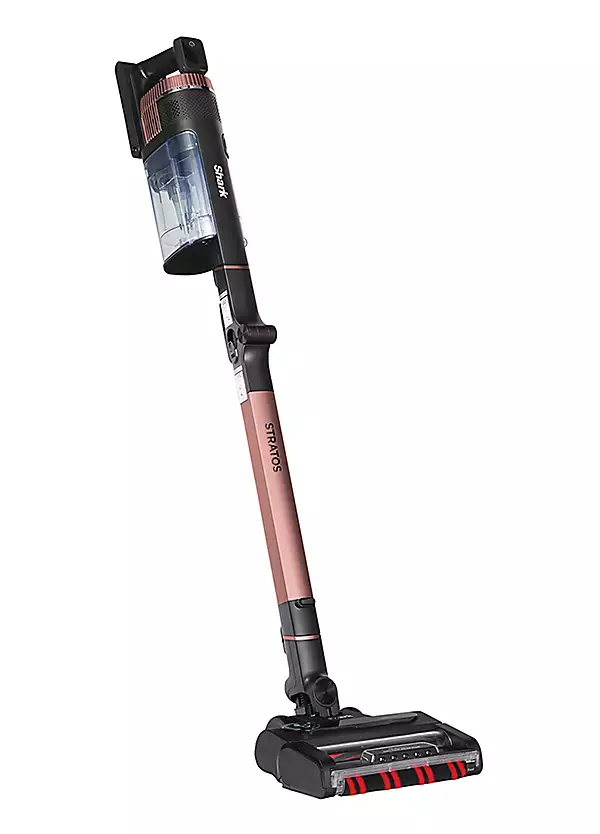
Shark Stratos Cordless (IZ862H)
Best for: Solid 5 to 7 year consumer lifespan with anti-hair wrap dual roller technology
Clean Sense IQ auto-power, DuoClean PowerFins and an odour neutraliser for pet homes on a budget.
- Rated suction
- Not published
- Runtime
- 60 min
- Noise
- 79 dB
- Weight
- 4 kg
Best for
- Self-cleaning brushroll never needed scissors in a month of testing
- Odour cartridge really works in a litter-box room
- Bends flat to reach under furniture
Not ideal if
- Heavier than Dyson at 8.8 lb, per independent testing
- Battery is slower to charge (4 h)
Vacuum Lifespan by Brand & Format
Expected real-world lifespan based on motor design, parts availability, and technician service records:
| Brand | Typical Format | Expected Lifespan | Primary Point of Failure | Part Availability |
|---|---|---|---|---|
| Miele | Bagged Canister / Stick | 15 – 20 Years | Cord reel spring; hose handle latch | Exceptional (15+ yrs) |
| SEBO | Bagged Canister / Upright | 15 – 25 Years | Brushroll bristles (wear part) | Industry Benchmark (20+ yrs) |
| Numatic (Henry) | Commercial Canister | 15 – 20 Years | Power switch; carbon motor brushes | Exceptional worldwide |
| Dyson | Cordless Stick | 4 – 6 Years | Lithium battery cell degradation | Readily available OEM |
| Shark | Cordless Stick / Upright | 5 – 7 Years | Plastic hose split; wand neck joint | Limited internal parts |
| Roborock / Dreame | Robotic Vacuum & Mop | 3 – 5 Years | LiDAR optical bearing; wheel motor | Good modular modules |
| Bissell / Hoover | Budget Bagless Upright | 3 – 5 Years | Motor bearing heat seizure; belt | Cheap generic parts |
The Engineering Secret: Why Bagged Vacuums Outlast Bagless Units by 300%
The single biggest determining factor in whether a vacuum lasts 5 years or 20 years is not its brand name—it is whether it uses a bagged or bagless dirt container:
In a Bagless Vacuum
When you vacuum fine dust, silica, and dry carpet shampoo with a bagless vacuum, the microscopic particles must be separated by plastic centrifugal cyclones. No cyclone is 100% efficient. Over time, ultra-fine microscopic grit inevitably bypasses the washable sponge filter and enters the motor housing.
This abrasive dust acts like sandpaper on high-speed copper commutators, ball bearings, and fan impellers. Within 4 to 6 years, the motor bearings begin to squeal, air friction increases, and the motor burns out from thermal overload.
In a Sealed Bagged Vacuum (Miele & SEBO)
In a modern bagged vacuum, the bag itself is made of 9 layers of electrostatically charged, melt-blown synthetic fiber. Over 99.5% of all dust is captured inside the sealed bag before the air ever enters the motor chamber.
As a result, a Miele or SEBO motor running in 2026 has internal fan impellers that look as spotless and dust-free as the day they left the factory in Germany.
1. Miele — The 20-Year Luxury Standard
Founded in Germany in 1899, Miele’s corporate motto is “Immer Besser” (Forever Better). That philosophy is reflected directly in their vacuum testing protocols.
Durability Highlights
- 1,000-Hour Motor Stress Testing: Before any vacuum model is approved for mass production, Miele tests the motor for 1,000 continuous hours—equivalent to vacuuming for an hour every week for 20 years.
- Tough-as-Nails ABS Polymer: The outer shell of Miele canisters is molded from high-impact ABS (the same material used in automotive bumpers and police riot helmets). It can withstand being pulled into door frames, bumped into radiator covers, and tumbled down stairs without cracking.
- 15-Year Spare Parts Guarantee: Miele guarantees the availability of functional replacement parts for at least 15 years after a specific model series is discontinued.
2. SEBO — The Commercial German Benchmark
While Miele is widely known in consumer retail, SEBO is the quiet champion favored by professional hospital cleaners, carpet mills, and vacuum service shops.
Durability Highlights
- Zero-Tool Field Maintenance: SEBO machines are engineered around mechanical repairability. You can replace the brushroll with a simple button click, clear a clog through an access door with zero tools, and replace drive belts without dismantling the chassis.
- Electronic Motor Protection: If a sock or rug edge wraps around the roller, a microcomputer instantly stops the motor in milliseconds to prevent burning the drive belt or bending the axle.
- 20+ Year Part Availability: SEBO stocks replacement motors, switches, and wheels for machines built in the 1980s and 1990s.
3. What About Cordless Brands Like Dyson and Shark?
Cordless stick vacuums are engineering marvels for daily convenience, but no battery-powered vacuum will ever last 20 years. The laws of lithium battery chemistry make that impossible:
- The 500-Cycle Limit: Lithium-ion cells lose 20% to 30% of their chemical capacity after 400 to 500 full charge cycles. In a typical home vacuuming every two days, battery performance drops noticeably after 2.5 to 3 years.
- The Dyson Advantage (Click-In Batteries): On modern Dyson models (like the Dyson V15 Detect and V12), the battery unclips with a single red button. When the battery degrades at year 3, you can buy a new official battery for ~$100 and restore 100% factory runtime, extending the machine’s total life to 6–8 years.
- The Shark Challenge (Modular Disposability): Shark offers fantastic cleaning performance at lower prices, but does not sell replacement motor heads or circuit boards for many stick models. If an internal wiring harness snaps inside a folding joint, Shark typically replaces the entire vacuum under warranty or instructs the owner to replace the machine.
The 50% Rule for Vacuum Repairs
If your vacuum begins to lose suction, makes grinding noises, or fails to turn on, how do you know whether to repair it or replace it?
Follow the 50% Rule:
- If the cost of parts and labor is less than 50% of the price of an equivalent new vacuum, and the machine is a high-durability brand (Miele, SEBO, Numatic), repair it. Replacing a $40 switch or $20 belt on a $900 Miele is a brilliant investment that buys another 5 to 10 years of use.
- If the cost exceeds 50%, or if the vacuum is a sub-$150 plastic bagless unit where parts cannot be purchased, recycle the unit and invest in a machine engineered for long-term ownership.
Frequently Asked Questions
What brand of vacuum cleaner lasts the longest?
Miele and SEBO manufacture the longest-lasting vacuum cleaners in the world. Engineered in Germany, their bagged canister and upright models are tested for 1,000 to 1,500 operating hours—the equivalent of 15 to 20 years of typical residential use. Supported by thick ABS plastic, steel axles, and decades of spare part availability, they are the gold standard of 'Buy It For Life' appliances.
Why do bagged vacuums last so much longer than bagless vacuums?
In bagless vacuums, fine abrasive grit (silica, drywall dust) inevitably bypasses cyclone chambers and passes directly through the motor fan and bearings, accelerating mechanical wear and thermal overheating. In bagged vacuums, multi-layer filter bags trap 99% of dust before air reaches the motor compartment, keeping internal motor bearings clean for decades.
How long does a Dyson cordless vacuum last?
A Dyson cordless stick vacuum typically lasts 4 to 6 years. The digital motor and cyclone assembly can easily last longer, but the lithium-ion battery naturally degrades after 400 to 500 charge cycles (about 2.5 to 3 years). Fortunately, modern Dyson models feature click-in battery packs that can be swapped in seconds for $80–$100, extending the vacuum's life to 6–8 years.
Which vacuum brand is the easiest to repair yourself?
SEBO is widely regarded by vacuum repair technicians as the easiest brand to service. Their machines are modular, assembled with simple screws rather than glued plastic clips, and allow tool-free access to brushrolls, drive belts, and clog inspection doors. SEBO also maintains spare parts availability for 15+ years after a model is retired.
Related In-Depth Articles & Analysis
Related Buying Guides

If you buy through a link on this page, we may earn an affiliate commission at no extra cost to you. How we’re funded →